

Analytics
Overview:
The Overview and Analytics functionality on Nanonets allows you to view aggregated data through various filters and shortcuts, as well as monitor the health of your workflow by seeing which files require review and which files are correctly processed.
The Analytics function also allows you to pull customised reports on your workflow data - so you can get deeper insights into model performance, generate reports on AP vendor invoice processing, and so on.
How to access Overview and Analytics:
You can access these screens using the Left-Hand-Side dashboard menu. Both of these screens are under the Overview tab in your Active Workflow.
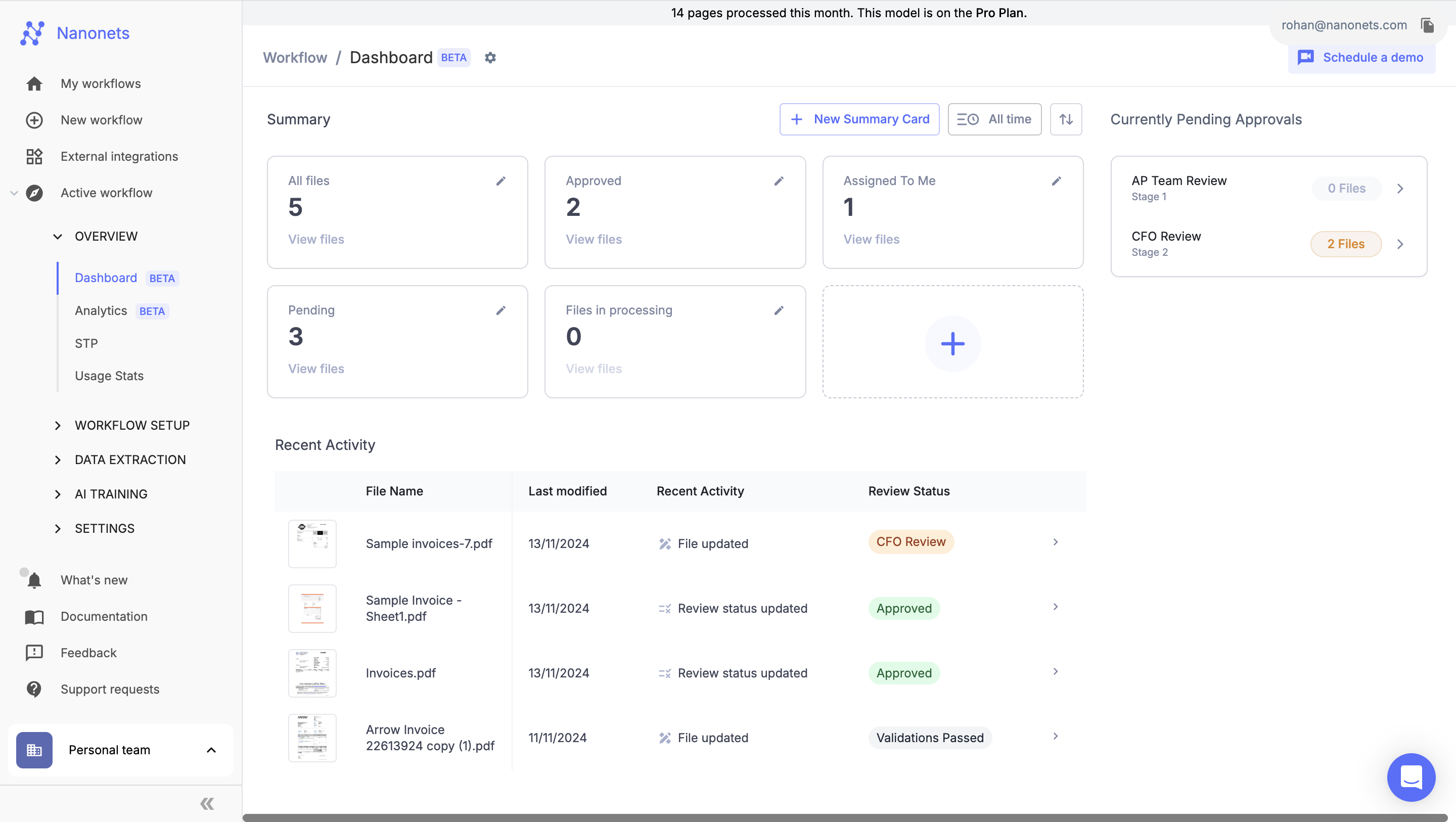
The Overview screen has 3 main sections:
- Summary Cards: This is where you can view a summary of your workflow files and create filters to access certain types of files directly (such as all files Assigned to You for approval)
- Currently Pending Approvals: This is where you can see which files in your workflow are stuck at certain approval stages, and take action on them
- Recent Activity: This section highlights which files have been recently worked on by anyone in your team
Analytics:
The analytics feature allows you to customise a report on your workflow data, and then download it. You can create filters, groups and measures to track (similar to an Excel Pivot Table) and then run the report, download it once the results are satisfactory, or send it on a schedule to a recipient.
There are two ways to get started: pick one of the templates, or click Create new report in the top-right corner.
Either way, you land in the report builder — a left-hand preview of your data, and a right-hand panel that you can use to set up your report. Three tabs sit in this panel:
- Configure - this is what you use to pick the data you want to display
- Visualization - chart form of the same report
- Schedule - send this report out on a recurring basis
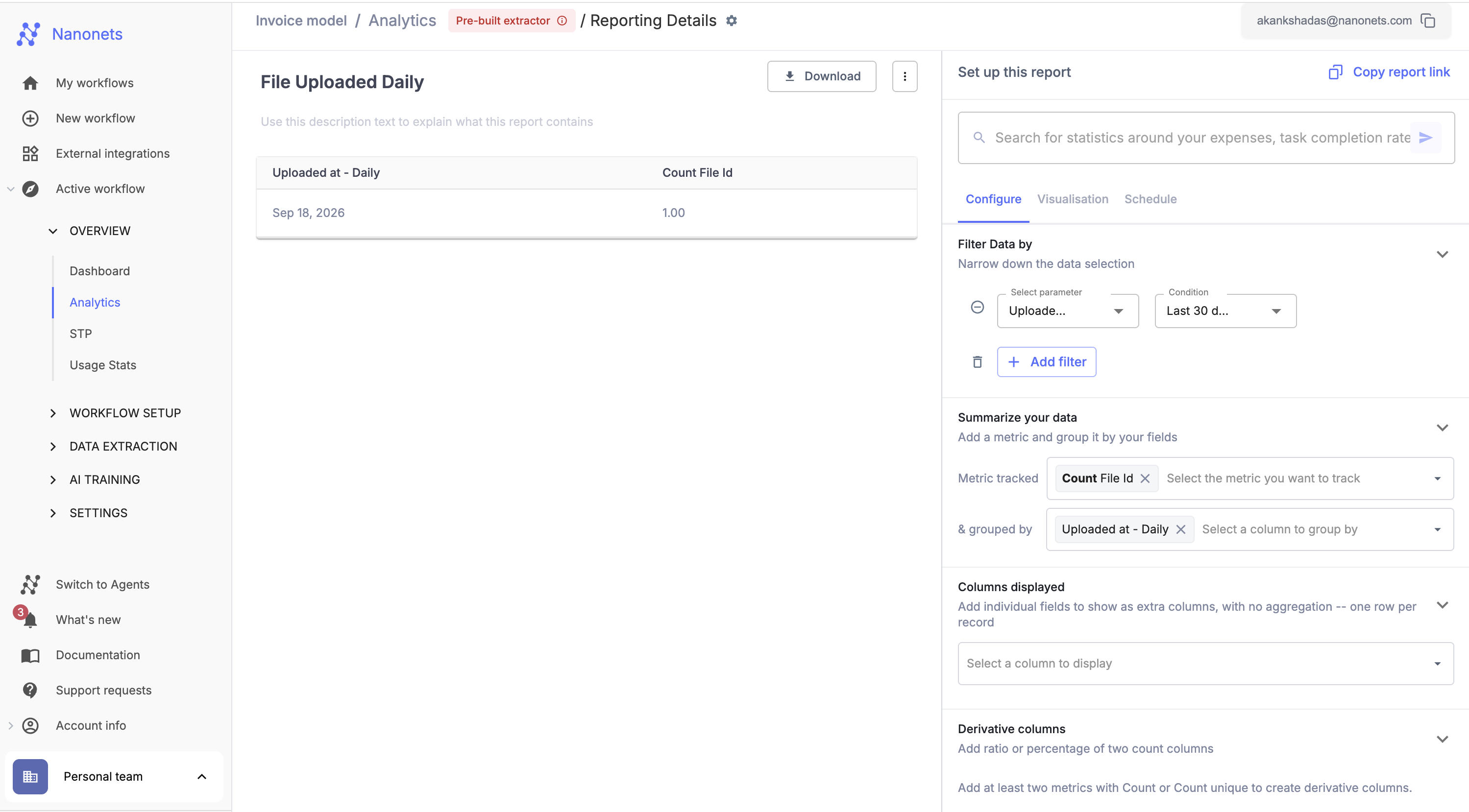
The Configure Tab
Filter Data By
The first section narrows down which records your report looks at, before anything else is calculated.
Each filter is a parameter (a field in your workflow, or a built-in one like Review status or Upload date) and a condition (is, is not, contains, exists, between, a date range like Last 7 days, and so on). Add as many as you need with + Add filter - a record has to satisfy all of the filters to be included.
Summarize Your Data
This is the classic pivot-table section: pick a metric to track, and optionally group by one or more fields.
Metric tracked is an aggregation over a field — Sum, Count, Count unique, Average, Maximum, Minimum, or Median of whichever field you choose (e.g. Maximum of Tarrif).
Grouped by adds one or more dimensions to pivot the metric across — group by Vendor_Name to see the metric per vendor, or stack a second grouping (e.g. also by Invoice_Date) to break it down further. Date fields get an extra option here: a date-range granularity (Daily, Weekly, Monthly, and so on), so you can group "by day" or "by month" instead of by exact timestamp.
This section is built for aggregated answers: e.g., total approved tarrif per vendor, count of files per upload day, average line tariff per part number, etc.
Columns Displayed
Sometimes you don't want a rollup — you want the underlying rows themselves without any math applied. That's what this section is for.
Add any field here — file-level (Vendor_Name, Invoice_Date) or line-item level (Quantity, Line_Tariff) — and the report becomes a flat table: one row per actual record (or per line item, for table fields), with your chosen fields as columns. Nothing is grouped, summed, or averaged.
This is the right tool when the question is "show me the data" rather than "show me a total" — e.g., a list of every approved invoice line with its part number, quantity, and tariff, for instance.
Derivative Columns
Once you have at least two Count-type metrics in Summarize your data, this section lets you add a calculated column from them — a ratio (A ÷ B) or a percentage ((A ÷ B) × 100). Useful for things like a pass rate: e.g., % of files approved over the last 7 days.
Summarize vs. Columns Displayed
Columns displayed takes priority over summarized data for the table
These two sections can be filled in at the same time, but they answer different questions. As soon as you add any field to Columns displayed, the table shows your raw columns, one row per record. Your Group By/Metric selections won't be displayed in the table if both Columns Displayed and Summarize sections are populated (though they still drive the Visualization chart independently).
To get a grouped/aggregated table back, clear the Columns displayed section.
| You Want... | Use |
|---|---|
| A total, average, or count broken down by a field | Summarize your data |
| A raw list of files or line items | Columns Displayed |
| A chart of a total over a dimension | Summarize your data + Visualization |
Visualization
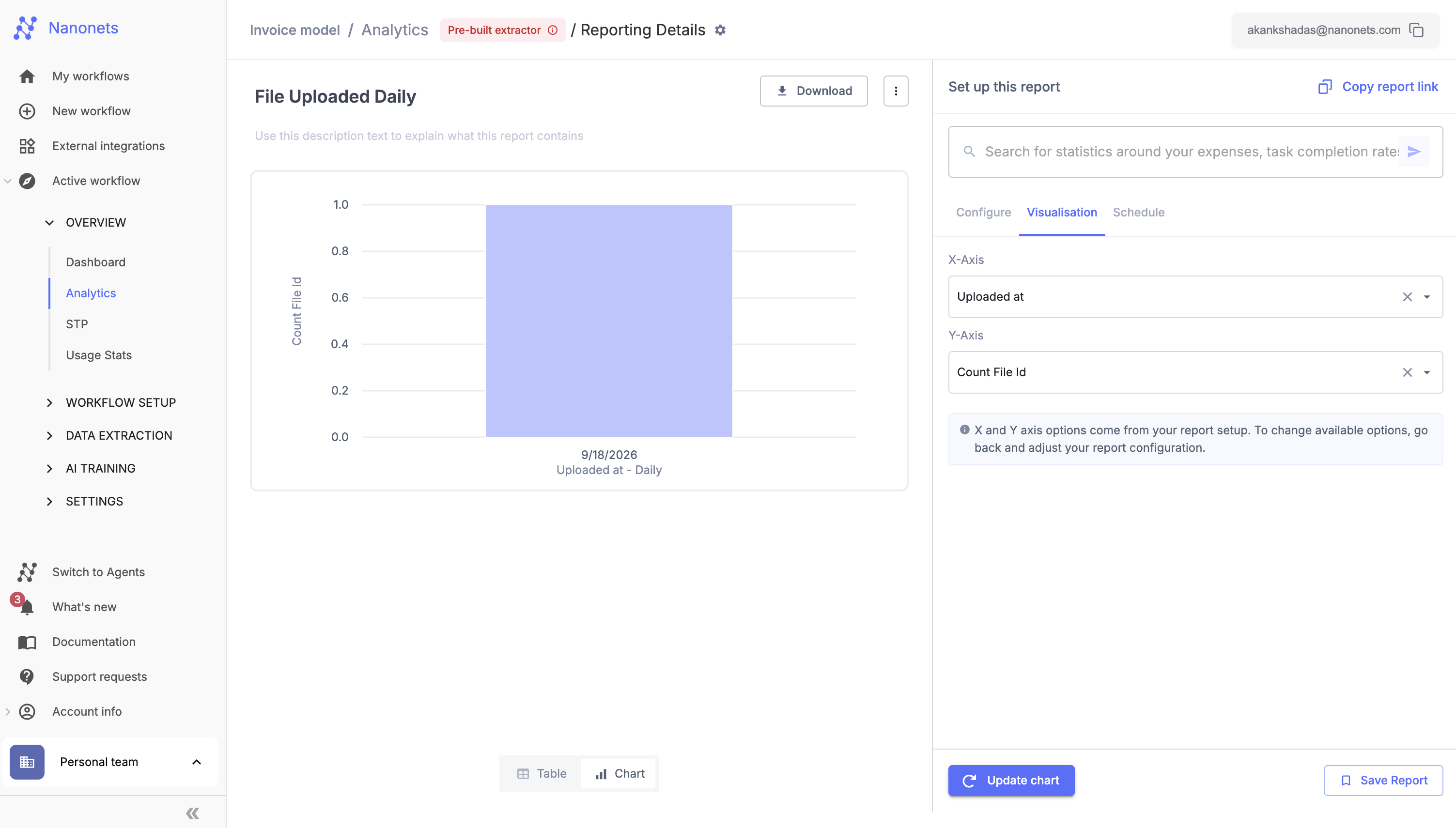
Switch to the Visualization tab to see your Summarize your data selections (Grouped By → X-axis, Metric → Y-axis) as a chart, independent of whatever the Configure table is currently showing.
Schedule
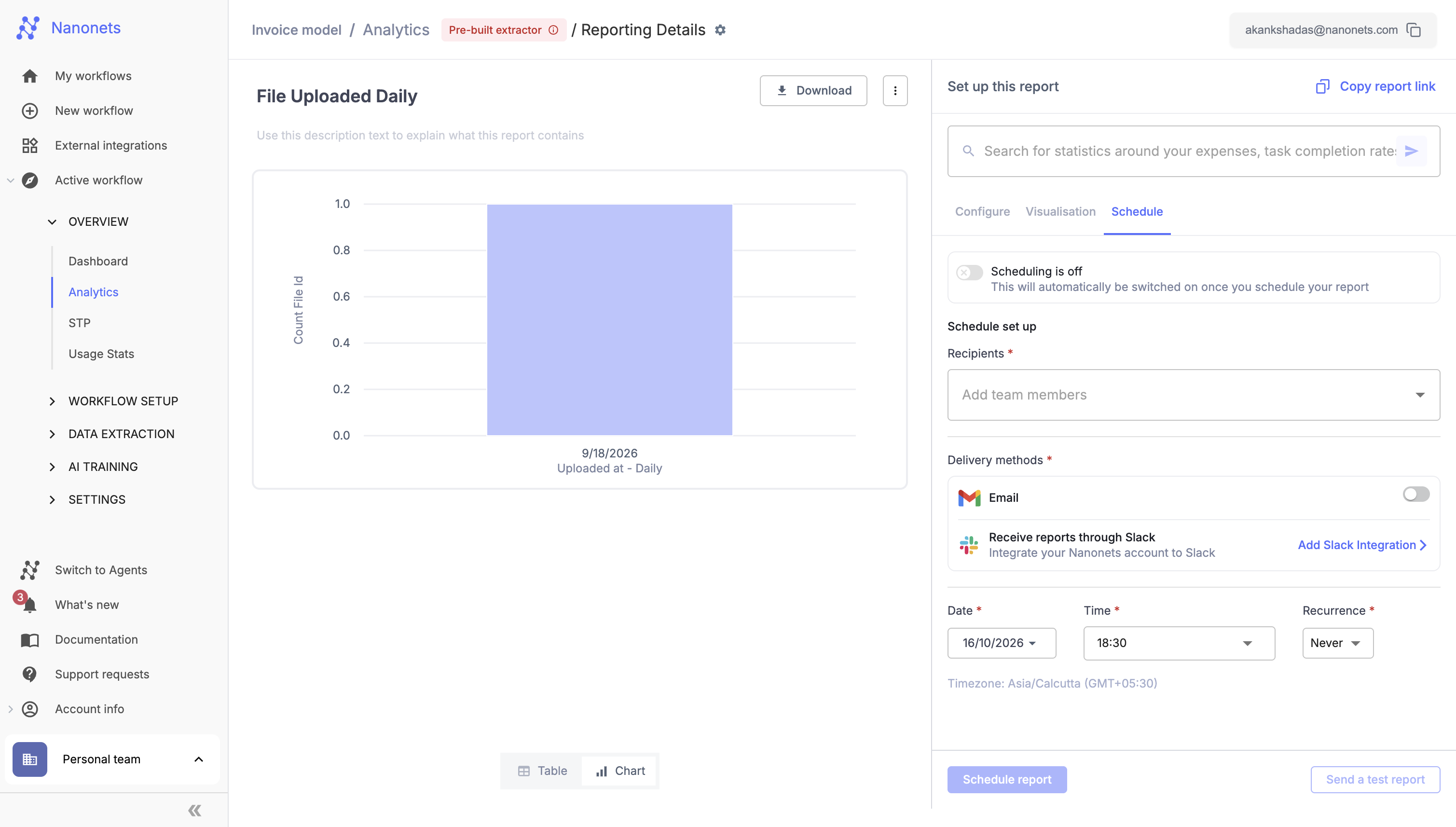
Turn any saved report into a recurring delivery: pick a frequency (daily, weekly, monthly, quarterly, yearly), and send it by email or Slack to chosen recipients or team groups. Scheduled runs use whatever configuration was last saved for that report — so make sure to save before turning scheduling on.
Saving & reusing a report
Saving & reusing a report
Save report stores your current Filter / Summarize / Columns / Derivative configuration under a name and description, so you (or a teammate) can reopen it later without rebuilding it. Your Configure panel always reflects whichever saved report you have open, and edits only stick around for other viewers once you explicitly save again.
As an enhancement, Nanonets also provides the ability to create reports with Natural Language.
Walkthrough: a filtered, raw-data report
Walkthrough: a filtered, raw-data report
As a worked example, here's how to build "every approved invoice number that has a tariff, from the last 7 days, along with the vendor it came from, and the corresponding tarrif":
- Filter Data by — add Review status is Approved, and Upload date Last 7 days.
- Filter Data by — add one more: your tariff field, condition exists. This drops any line item with no tariff.
- Leave Summarize your data empty — you want raw rows, not a rollup.
- Columns displayed — add Vendor_Name, Invoice_Number, and your tariff field.
- Click Update results to preview, then Save report to keep it.
Updated 20 days ago